Published November 4, 2026 • 7 min read
You have probably seen the headline making the rounds this week: a new study says average PFAS levels in U.S. tap water may run about twice what official figures suggest. If you live in Meridian and just scrubbed the white crust off your kettle, you may have wondered whether that crust and "forever chemicals" are the same problem. They are not. This is the one in your kitchen right now, and it is the one you can see.
We are a water treatment company serving Meridian, Boise, Eagle, Star, Kuna, Nampa, and Caldwell, and we get this question constantly. Here is what the news actually says, what Meridian scale buildup is, and how to clean it and stop it.
What the PFAS Study Says, and What It Does Not
According to reporting on the study, researchers led by Gehendra Kharel of Texas Christian University reworked about 1.86 million EPA test results from nearly 10,000 community water systems. They found that conventional averaging captured only about 44 percent of the estimated average PFAS concentration. In plain terms, many results fall below detection limits and get counted in a way that can understate the real average.
The authors were careful about the limits of that work. It does not show that individual water systems are breaking federal standards, and it does not show that people are exposed to more than previously thought. It is a statistics finding, not a Meridian finding. For background on what PFAS are and how they are regulated, the EPA PFAS page is the best starting point, and the earlier USGS tap water study covers national detection rates.
Two Different Problems With the Same Faucet
This is the part that gets lost when water is in the news. Your tap can have more than one issue at the same time, and each one needs its own fix.
- Hardness (scale): dissolved calcium and magnesium. You see it as white crust, spotted glasses, and weak showerheads.
- Chlorine: added to city water to control microbes. You notice it as a pool smell or taste. See our guide on why Meridian water can smell like chlorine.
- PFAS and similar chemicals: synthetic compounds you cannot see, smell, or taste. Only lab results tell you.
A water softener addresses the first one. It does not address the second or third, and any company that implies otherwise is overselling. We would rather tell you that up front than have you buy the wrong equipment.
Why Meridian Water Leaves Scale Behind
Meridian pulls its drinking water from groundwater wells in the Boise aquifer. As that water moves through sand, gravel, and rock, it picks up calcium and magnesium. We commonly see Meridian hardness land between 12 and 17 grains per gallon, and the USGS hardness scale calls anything over 10.5 grains per gallon very hard.
Hardness varies by zone and well, so your number may differ from a neighbor across the subdivision. The City of Meridian water quality reports list hardness and other measurements by zone, and the Meridian Water Division can answer questions at 208-888-5242.
When a drop of that water dries, the water leaves and the minerals stay. One drop leaves almost nothing. Thousands of drops a day, every day, build a crust. Heat speeds it up, which is why the worst spots are the kettle, the showerhead, and the water heater.
Where Scale Shows Up First in a Meridian Home
If you are not sure whether scale is a real problem in your house, walk through these spots. Most Meridian homes show at least three.
- Faucet aerators: the small screen at the tip clogs with white grit and the stream gets uneven or sprays sideways.
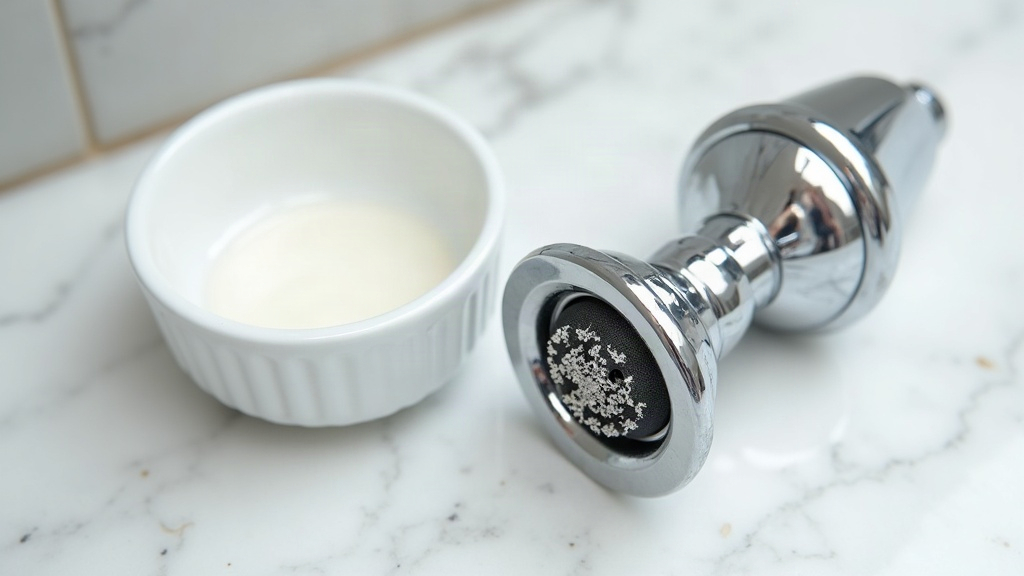
- Showerheads: missing spray holes and a weak or split spray pattern. Our post on clearing hard water film from shower doors covers the glass side.
- Electric kettles and coffee makers: a chalky ring or flakes at the bottom. See our kettle descaling guide.
- Dishwashers: cloudy glasses and a film on dark plastic. Scale also coats the heating element, as we explain in dishwasher hard water damage in Meridian.
- Water heater: popping or rumbling sounds as water bubbles under a layer of sediment.
Scale inside pipes and heater tanks is out of sight, and that is where it costs the most over the years. A layer of scale insulates a heating element from the water it is supposed to heat, which makes it work harder and can shorten its life.
How to Remove Scale Buildup Safely
For existing buildup, household acid does the job. White vinegar dissolves calcium carbonate with no special equipment.
- Showerhead: fill a plastic bag with white vinegar, tie it over the showerhead, and leave it 30 to 60 minutes. Wipe, then run hot water for a minute.
- Faucet aerator: unscrew the tip, soak it in vinegar for 30 minutes, brush out the grit, and screw it back on.
- Kettle: simmer a half-and-half mix of vinegar and water, let it sit 20 minutes, then rinse twice and boil plain water once.
- Faucet bodies and tile: wrap a vinegar-soaked cloth around the fixture for 15 to 20 minutes, then wipe.
Two cautions. Never use vinegar on natural stone such as marble or travertine, because the acid etches it, and never mix vinegar with bleach. For anything under warranty, check the manufacturer's care instructions first.
Cleaning Treats the Symptom. Softening Treats the Cause.
Descaling works, and then the scale comes back. In a very hard water home, many families end up descaling something every few weeks. A water softener swaps calcium and magnesium for sodium or potassium in the water before it reaches your fixtures, so the minerals that form the crust never arrive.
What homeowners tend to notice first is the fixtures staying cleaner and the shower spray staying even. Over a longer period, appliances and water heaters are not fighting a mineral layer. A quality softener typically runs $2,500 to $4,500 installed in the Treasure Valley, depending on the size of the home and the plumbing. Our water softener cost calculator walks through sizing and cost for your household.
If PFAS is the thing keeping you up at night, a softener is not the answer, and we will say so. The right next step there is checking your city's published results and, if you want added protection, a point-of-use filter certified for PFAS reduction. Many Meridian households end up wanting both: softening for the whole house and a certified filter at the kitchen tap.
What to Do This Week
Pick the order that costs you the least. First, descale the kettle and showerhead so you can see how fast the crust returns; if it is back in a month, your water is doing it. Second, find your zone's hardness number in the city report. Third, get a test at your own tap, because what comes out of your faucet is what counts, not a city average.
A free water test from our team measures your hardness and iron on the spot and gives you a clear answer on whether a softener makes sense. If it does not, we will tell you that too.
Frequently Asked Questions
Get Your Real Hardness Number
A free water test at your tap shows your exact hardness and iron. No pressure, just your results.