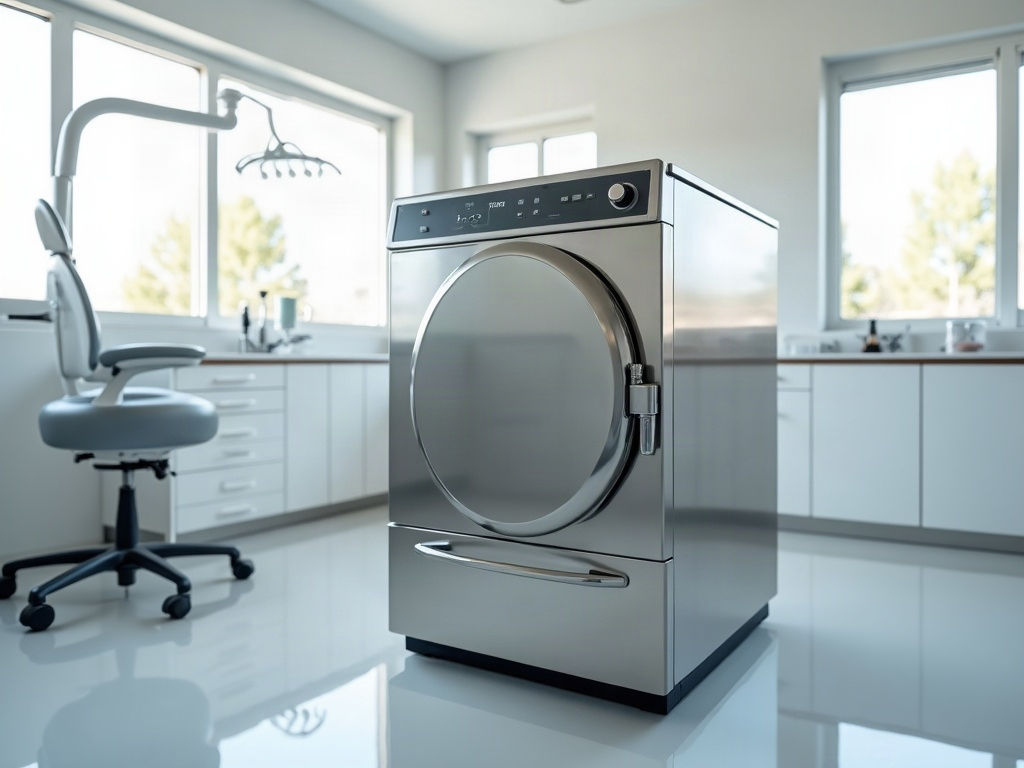
Most dental practices in the Treasure Valley run their autoclaves and dental unit waterlines on untreated tap water. Right now, in 2026, that decision is costing more than usual, and the bill shows up as maintenance calls, failed sterilizer cycles, and waterline compliance headaches that almost no one traces back to the correct source.
Idaho's 2026 water year opened with a record: the Boise Basin's snowpack exhausted earlier than any year on file, forcing reservoir drawdowns through the entire summer. With less snowmelt diluting mineral load in Treasure Valley's supply, calcium and magnesium concentrations in Boise municipal lines are measurably higher than in an average year. For dental offices running autoclaves and dental unit waterlines on untreated tap water, that elevated total dissolved solids (TDS) translates directly into accelerated scale buildup and equipment failures that most practice managers misattribute to vendor defects or aging hardware.
The hidden cause is the water. Here is what we are seeing across Boise, Meridian, Eagle, and Nampa, and what dental practices can do about it before the next repair bill arrives.
Why Idaho's Water Is Unusually Hard Right Now
Treasure Valley water hardness comes from the aquifer system underlying the Snake River Plain. Municipal wells in Boise draw from rock formations saturated with calcium carbonate and magnesium sulfate. Under normal conditions, spring snowmelt from the Boise River watershed dilutes reservoir levels and temporarily reduces TDS in the distribution system. In 2026, that dilution phase was short and weak.
Boise municipal tap water typically tests between 10 and 15 grains per gallon (gpg). Meridian, whose supply comes from deeper wells with longer mineral contact time, typically runs 12 to 17 gpg. Eagle and Star fall in a similar range to Meridian. Nampa and Caldwell draw from both municipal wells and some Snake River rights, which historically runs slightly softer, but still well into the "very hard" classification above 10 gpg.
For context: water above 7 gpg is classified as hard by the Water Quality Association. Water above 10 gpg is classified as very hard. At 12 to 17 gpg, scale accumulation inside enclosed plumbing and heated vessels is not a slow process. It is aggressive and continuous.
In 2026, with TDS trending toward the high end of those ranges, the rate of scale accumulation inside dental equipment is faster than what practices have been budgeting for in previous years.
What Hard Water Actually Does Inside an Autoclave
An autoclave sterilizes by generating steam under pressure. The heating element heats water to produce that steam. When the water feeding the reservoir contains dissolved calcium and magnesium, every steam cycle leaves behind a thin mineral deposit on the heating element, chamber walls, and valve seats. That deposit is scale, and it compounds.
Scale on the heating element acts as an insulator. The element has to work harder and run hotter to transfer the same amount of heat through an increasingly thick mineral layer. That extra thermal stress shortens element lifespan directly. Scale in valve seats prevents valves from seating cleanly, which means pressure cycles become inconsistent, and inconsistent cycles mean unreliable sterilization.
A well-maintained autoclave on treated water lasts 10 to 15 years. The same model running on Boise or Meridian tap water without a pre-treatment system typically reaches end-of-life in 5 to 7 years. That is a $4,000 to $8,000 replacement cost absorbed 5 to 8 years ahead of schedule.
Service calls triggered by scale failures, clogged solenoid valves, and failed pressure tests run $500 to $2,000 per visit, depending on the repair and whether parts need to be ordered. Practices that have not treated their water budget two to three of these calls per year as a cost of doing business. They should not have to.
Dental Unit Waterlines: The CDC and ADA Standard You Must Meet
Autoclaves are visible and their failures are obvious. Dental unit waterlines are quieter about the damage hard water is doing, which makes them more dangerous from a compliance standpoint.
The CDC recommends that water used in dental treatment procedures contain fewer than 500 colony-forming units per milliliter (CFU/mL). The ADA sets a more stringent target of fewer than 200 CFU/mL, aligning dental water quality with EPA drinking water standards.
Meeting those standards is not just about using a waterline disinfectant. Scale buildup inside waterline tubing creates a rough, porous surface that biofilm clings to. Biofilm embedded in scale is protected from chemical disinfectants in a way that biofilm in a clean tube is not. Practices running hard water through untreated waterlines often find that shock treatment and weekly disinfection protocols still produce high CFU counts at quarterly testing, and they cannot figure out why the chemicals are not working.
They are working. The problem is that the scale is protecting the biofilm from the chemicals. Remove the scale through pre-treatment, and your disinfection protocols perform as designed.
Idaho DEQ regulates water quality at the municipal supply level, not at the dental unit. Your tap water meets public drinking water standards. It does not meet dental-grade waterline standards without additional treatment at the point of use. That gap is the practice's responsibility, not the city's.
The Hidden Costs Dental Practices Miss
When we talk with dental office managers in Boise and Meridian about water quality, the initial conversation is almost always about the autoclave. The broader cost picture takes a few minutes to work through, because the expenses are spread across budget categories and no one has added them up before.
Here is what hard water actually costs a busy dental practice annually in the Treasure Valley:
- Autoclave service calls: $500 to $2,000 per visit, typically two to three times per year on untreated water
- Premature autoclave replacement: A unit that should run 12 years lasts 6 on hard water; $5,000 to $8,000 absorbed early
- Waterline disinfection product overuse: When disinfectants do not achieve target CFU counts because of scale-protected biofilm, practices increase frequency and concentration, spending more on products while still failing tests
- Failed waterline testing: Quarterly or semi-annual third-party waterline tests that come back above 200 CFU/mL require remediation testing, adding cost and staff time
- OSHA and regulatory audit exposure: Documented waterline failures during an OSHA inspection or dental board review create liability that is difficult to quantify but real
- Handpiece wear: Hard water residue inside high-speed handpiece turbines accelerates bearing wear and increases handpiece service intervals
- Revenue lost to downtime: An autoclave that fails mid-morning shuts down sterilization for the day; a four-operatory practice losing one production day loses $4,000 to $8,000 in collected revenue
When you add those numbers, the annual cost of untreated hard water in a busy dental practice frequently exceeds the full installed cost of a water treatment system. The treatment system is a capital expense that pays back in the first year and then saves money every year after that.
RO vs. Water Softener vs. DI: What Dental Offices Actually Need
The water treatment market offers three primary technologies for managing hardness and TDS in commercial settings: ion-exchange water softeners, reverse osmosis (RO) systems, and deionization (DI) systems. Each removes minerals differently, and for a dental practice, none of them is the right standalone solution. The right answer is a combination.
Ion-Exchange Water Softener (Whole-Office Pre-Treatment)
A whole-building softener installs at the point where water enters the building. It replaces calcium and magnesium ions with sodium ions through a resin bed, eliminating hardness from every water outlet in the building. This protects autoclaves, handpieces, steam sterilizers, ultrasonic cleaners, water heaters, and waterlines from scale accumulation. It does not remove all dissolved solids; softened water still contains sodium and other minerals. For most equipment in a dental office, softened water is sufficient. For the autoclave, you want to go one step further.
Point-of-Use RO or DI at the Autoclave
Reverse osmosis membranes filter water down to near-pure levels by pushing it through a semi-permeable membrane under pressure. Deionization uses resin beds that pull all ionic content from the water, producing resistivity close to laboratory-pure water. Both are appropriate for the autoclave reservoir, where even small amounts of dissolved solids will accumulate over thousands of steam cycles.
The practical workflow for a Treasure Valley dental office is: whole-building softener as the primary pre-treatment, removing hardness from all water entering the building, plus a point-of-use RO or DI unit feeding the autoclave reservoir. The softener does the heavy lifting for the entire building. The RO or DI unit provides the near-pure water the autoclave manufacturer actually specifies in the owner's manual (check yours; most do specify distilled or deionized water).
What Does Not Work Alone
A point-of-use RO at only the autoclave leaves the rest of your equipment on hard water. Your waterlines, handpiece lines, and steam jenny will continue to scale. A standalone softener without RO at the autoclave provides excellent protection for everything except the sterilizer itself, which still gets some TDS from softened water. Neither approach alone covers the full equipment inventory. The combination does.
For more context on how hard water affects equipment across different commercial settings in the Treasure Valley, see our overview of how Meridian hard water damages professional equipment in other commercial settings.
What Treasure Valley Dental Offices Should Do Right Now
If your practice is in Boise, Meridian, Eagle, Nampa, Caldwell, Kuna, or Star, and you have not had a water quality assessment, these are the four steps to take before the next repair cycle hits.
- Test your incoming water hardness. You can request current TDS and hardness data from your municipality, or we can conduct a free on-site water test when we assess the building. Know your actual number, not a regional average. Meridian wells vary by neighborhood; some run closer to 12 gpg and some closer to 17.
- Inspect your autoclave for existing scale. Open the reservoir lid and look at the interior walls and heating element housing. White or gray mineral deposits are scale. If it is visible to the eye, it has already been accumulating inside the sterilization chamber and valve assemblies for longer than it looks.
- Pull your waterline disinfection logs and your most recent CFU test results. If you are running a weekly or monthly disinfection protocol and still testing above 200 CFU/mL, scale-protected biofilm is the most likely explanation.
- Call us for a site assessment. We will measure water hardness at the point of entry, walk through your sterilization room, and give you a specific recommendation for your building size, water pressure, and equipment configuration. There is no charge for the assessment, and we will not pressure you into a system that does not fit your practice.
The phone number is (208) 968-2771. Office hours are Monday through Friday, 8am to 6pm, and Saturday, 9am to 4pm. We serve the entire Treasure Valley and we are familiar with the water characteristics of each city's distribution system.
Schedule a Free Water Assessment
We test your incoming water hardness, inspect your autoclave, and give you a specific treatment recommendation. No charge. No pressure.
Book Your Free AssessmentOr call us directly: (208) 968-2771
Frequently Asked Questions
Ready to stop the scale?
We serve dental practices across Boise, Meridian, Eagle, Nampa, Caldwell, Kuna, and Star. Free water test and equipment assessment, no commitment required.
Get My Free AssessmentCall or text: (208) 968-2771 • Mon-Fri 8am-6pm, Sat 9am-4pm