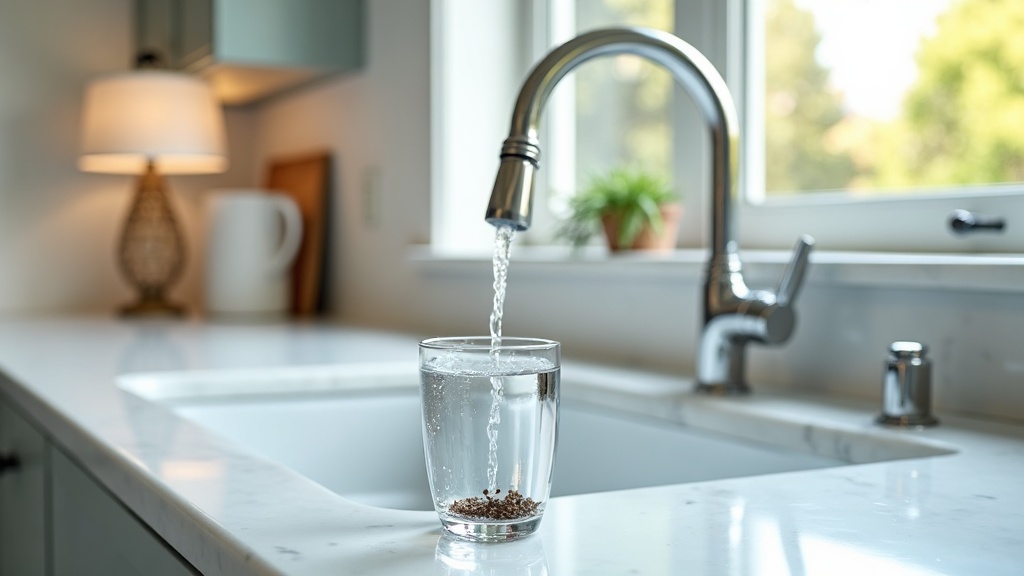
You fill a glass of water at the kitchen sink and notice tiny black flecks floating near the surface or settled at the bottom. Maybe they appeared this morning. Maybe they have been showing up for weeks and you finally decided to look into it. Either way, the right answer depends entirely on what those specks actually are. Not all black particles in tap water are the same, and the fix for one source can be completely wrong for another.
We work with homeowners across Boise, Meridian, Eagle, Nampa, and Caldwell regularly on exactly this question. Here is what we know about the most common causes in the Treasure Valley and how to tell them apart.
Why This Is Happening More in 2026: The Drought Connection
Canyon County's drought emergency, declared in April 2026, has stretched through the summer with real consequences for the water supply. KIVI TV reported that farmers are facing financial losses as water allotments from irrigation systems fed by the Snake River Plain Aquifer have been cut, with some fields left unplanted entirely.
That drought has a direct effect on what comes out of your kitchen tap. When surface water supplies drop, utilities rely more heavily on aquifer wells and shift their source water blending. Drawing harder on deeper aquifer wells can disturb naturally occurring sediment layers, including manganese deposits that are characteristic of Snake River Plain groundwater. At the same time, lower water tables and reduced flow through aging distribution pipes increases the likelihood of pipe corrosion particles dislodging and reaching residential taps.
Boise State Public Radio also noted that Boise adopted a new drought emergency ordinance this summer following exceptionally low snowpack, which has put the city's water supply management under additional pressure. If you have noticed black specks appearing or worsening this summer specifically, drought-related source water changes are a likely contributing factor.
Cause 1: Pipe Corrosion
Older homes in Boise and throughout the Treasure Valley were built with galvanized steel or iron supply pipes. These pipes corrode from the inside out over time, and the corrosion produces black, rust-brown, or dark gray particles that break off and travel to your faucet. The corrosion accelerates when water chemistry changes, when flow velocity increases after a pressure surge, or when there is disturbance in the main distribution line.
Corrosion particles tend to be irregular in shape and feel gritty between your fingers. They are often heavier than rubber bits and settle quickly to the bottom of a glass. If you run cold water and the specks appear from both hot and cold taps, and if your home was built before the 1980s, galvanized pipe corrosion is high on the suspect list.
This is the cause that warrants the most caution. Corroding iron pipes can also carry other contaminants, and older galvanized pipes sometimes contain lead solder at the joints. A certified water test is the safest way to confirm what you are dealing with before using the water for drinking or cooking.
Cause 2: Rubber Deterioration from Your Water Heater
This is the most common cause of black specks we see in Treasure Valley homes, and it is almost always the hot water tap that gives it away first. Water heaters contain flexible rubber components: dip tubes, inlet supply line hoses, and in some models, the anode rod bladder or flexible connector. Over time, these rubber parts degrade, break apart, and send small black or gray fragments downstream.
Hard water accelerates this process significantly. Boise tap water runs 10 to 15 grains per gallon (gpg). Meridian and the eastern Treasure Valley reach 12 to 17 gpg. At those hardness levels, mineral scale builds up on every surface water contacts, including inside your water heater tank. Scale buildup creates heat stress on rubber components, causing them to harden and crack faster than they would in soft-water conditions.
The test: if black specks appear predominantly or exclusively from your hot water tap, and they are soft and slightly flexible when pressed between your fingers, rubber deterioration is almost certainly the cause. This is generally harmless from a health standpoint, but it signals that your water heater components need inspection and likely replacement. A plumber can check the dip tube, inlet hose, and internal components.
Cause 3: Manganese from the Snake River Plain Aquifer
This one is specific to Idaho and is genuinely underappreciated in most generic articles about black specks in tap water. The Snake River Plain Aquifer, which supplies a significant portion of Treasure Valley groundwater, naturally contains elevated manganese levels. Manganese is a metal that occurs in bedrock and leaches into groundwater as it moves through the rock.
Idaho DEQ sets a secondary standard of 0.3 mg/L for manganese in drinking water. Secondary standards are non-enforceable guidelines based on aesthetic concerns like taste, odor, and appearance, not direct health limits. But manganese above that threshold causes water to run dark brown to black when it oxidizes on contact with air or chlorine. You may notice dark staining in sinks or toilets in addition to particles in your water.
Manganese particles are very fine, almost powdery, and settle slowly. They often look like tiny dark clouds when stirred in a glass rather than distinct floating specks. If you are on a private well in Canyon or Ada County, elevated manganese is worth testing for specifically, because drought conditions drawing water from deeper aquifer zones can pull up higher manganese concentrations.
If you have noticed similar issues with your water's appearance, our article on cloudy tap water in Boise covers the broader picture of how water source changes affect what reaches your tap, including the oxidation processes that make particles visible.
Cause 4: Activated Carbon Filter Breakdown
If you have a whole-house filter or a refrigerator filter with an activated carbon stage, this cause is worth checking first before assuming something is wrong with your pipes or water heater. Carbon block and granular activated carbon (GAC) filters contain millions of tiny carbon granules. At the end of a filter's service life, or if the filter media is damaged, those granules can break free and come out of your taps.
Carbon filter particles are distinctive: they are uniform, nearly perfectly round, very lightweight, and they are black. They also rinse away quickly and do not settle aggressively the way pipe corrosion does. If the particles appeared immediately after a filter change or if you have not changed your filter in longer than the manufacturer recommends, start here.
The fix is simple: replace the filter and flush the system. If particles continue after a new filter is installed, the filter housing itself may have a cracked media bed, or you are looking at a different source entirely.
Cause 5: Biofilm and Pipe Lining Breakdown
Some older distribution pipes and residential plumbing were lined with epoxy coatings as part of rehabilitation projects. Over time, particularly in areas with variable water chemistry, those linings can flake off and produce thin, flat black or dark brown particles that are more flexible than pipe corrosion but stiffer than rubber. These are less common in residential settings but worth knowing about.
Biofilm is a separate issue. In stagnant sections of pipe, bacteria form a dark film that can slough off under high flow conditions. This looks different from mineral or rubber particles, typically appearing as irregular, slightly gelatinous flecks rather than solid specks. If you notice this pattern after a period of low water use, like returning from vacation, running a few gallons to flush the line is a good first step.
How to Identify Which Type You Have
The fastest diagnostic at home takes five minutes. Fill a clean white bowl with water from your tap and let it sit for two to three minutes without disturbing it. Then use a clean white paper towel to scoop out a few of the particles and examine them.
- Soft and flexible: Rubber deterioration from water heater components. Check the hot tap specifically.
- Uniform, round, very black: Activated carbon filter media. Check when you last changed your filter.
- Gritty, irregular, heavy: Pipe corrosion. Likely from galvanized or iron pipes in older homes.
- Fine, powdery, disperses slowly: Manganese oxidation from aquifer water. Test your water.
- Flat, slightly flexible, thin: Possible pipe lining or biofilm flakes. Check water use patterns.
If you are on municipal water in Boise or Meridian and the specks appeared recently or after a main line event in your neighborhood, contact Boise Public Works or Veolia Water (your utility operator) to ask if there was any recent work or pressure event on your line. They are required to notify customers of significant water quality events, but smaller disturbances sometimes slip through without formal notice.
When to Be Concerned vs. When to Monitor
Not every black speck situation is an emergency. Carbon filter fragments and rubber bits are generally harmless. They are unpleasant and worth fixing, but they do not pose an immediate health risk for most adults.
Pipe corrosion and manganese are different. If you have confirmed or strongly suspect either of those sources, we recommend stopping use of the water for drinking and cooking until you get a certified lab test back. This is especially important for households with infants, elderly residents, or anyone immunocompromised.
The chlorine smell that Meridian residents notice is sometimes related to the same source water changes that affect particle levels, since utilities adjust treatment chemistry as they shift between water sources. If you are seeing black specks and smelling chlorine simultaneously this summer, the drought-related source blend shift is a reasonable explanation for both.
For well users in Canyon County, Ada County, or across the Treasure Valley, annual water testing is the baseline. Drought years like 2026 are a good reason to test more frequently, as aquifer drawdown can introduce minerals and sediment not normally present in your well at typical seasonal levels. The Idaho DEQ drinking water program maintains a list of certified testing labs, and the USGS groundwater quality program has detailed data on Snake River Plain Aquifer chemistry for homeowners who want the full picture.
What Water Softener Boise Can Do
We offer free in-home water tests that measure hardness, pH, iron, manganese, and total dissolved solids. If your black specks trace back to manganese, a combination sediment pre-filter and iron/manganese reduction system addresses the problem at the point of entry before water reaches any fixture. If hard water is accelerating rubber deterioration in your water heater, a water softener reduces the scale buildup that causes that damage, extending the life of your water heater and all connected appliances. A softener is not a particle filter on its own, but it changes the chemistry that makes so many of these problems worse over time.
If you are in Boise, Meridian, Eagle, Nampa, or Caldwell and seeing black specks in your tap water, the best first step is a free test so we know what we are actually dealing with. No guessing, no upselling a solution that does not fit the problem.
Not Sure What Those Specks Are?
We test Treasure Valley water and identify the source before recommending anything. Free in-home test, no pressure.
Frequently Asked Questions
Black specks in Boise tap water most commonly come from one of four sources: corroding galvanized or iron pipes, deteriorating rubber components in water heaters or supply lines, manganese oxidation from the Snake River Plain Aquifer, or breakdown of activated carbon filter media. Pipe corrosion produces irregular rust-brown to black particles. Rubber deterioration produces soft, flexible black flecks. Manganese produces fine black or dark brown sediment. Filter media breakdown produces uniform black granules that rinse away.
It depends on the source. Rubber deterioration and carbon filter fragments are generally harmless. Manganese above Idaho DEQ's secondary standard of 0.3 mg/L can cause taste and odor problems, and long-term elevated exposure has been linked to neurological concerns. Pipe corrosion particles may carry lead or other metals if the pipes are older. If you are unsure of the source, a certified water test is the safest next step before continuing to use the water for drinking or cooking.
A sudden appearance of black particles often points to a disturbance event: a nearby water main break, a pressure surge in the distribution system, or a change in source water that disturbs sediment in aging pipes. In the Treasure Valley, drought conditions in 2026 have forced utilities to draw harder on aquifer wells and shift source blends, which can stir up sediment in pipes and increase manganese levels. If you recently had plumbing work done or noticed a change in water pressure, that can also dislodge particles that had settled in older pipes.
Fill a clean white bowl with tap water and let the particles settle for a few minutes. Rubber bits are soft and pliable when you press them between your fingers. Carbon filter fragments are uniform, perfectly round, and rinse easily. Pipe corrosion particles are gritty, irregular, and often rust-brown or dark gray. Manganese sediment is very fine, almost like a powder, and turns brownish when disturbed. If particles appear from the hot water tap only, rubber or water heater corrosion is the most likely culprit. If both hot and cold are affected equally, look at pipes or manganese first.
A water softener alone does not filter black specks, but it plays a supporting role. For manganese specifically, a water softener combined with a sediment pre-filter or an iron and manganese filter is a common treatment approach. For pipe corrosion, a whole-house sediment filter and addressing the corroding pipes directly are the primary solutions. For rubber deterioration from water heater components, the softener helps by reducing the scale buildup that accelerates rubber degradation, extending the life of seals and valves. We recommend a water test first so we know exactly what you are dealing with before recommending a solution.
Get Your Free Treasure Valley Water Test
We identify what is in your water before recommending any treatment. Call (208) 968-2771 or book online.
Book a Free Test