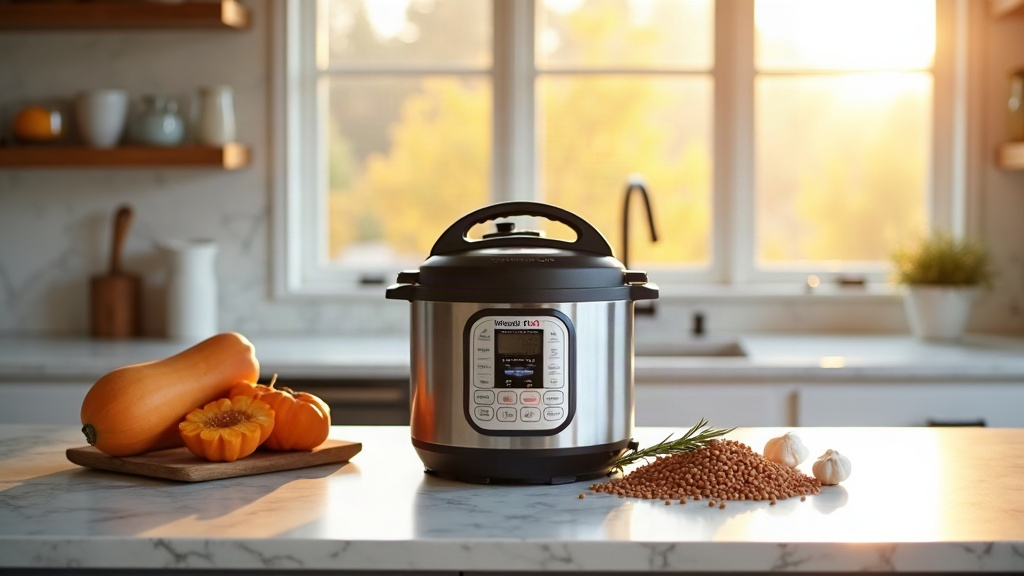
What if the reason your Instant Pot recipes never turn out like the video has nothing to do with your cooking skills? You followed the instructions. You soaked the chickpeas overnight. You set the pressure cooker to high for 40 minutes, maybe 50. You opened the lid expecting creamy, tender beans ready to go into your fall stew. And they were still firm. Still a little crunchy in the center. Still not right.
Every fall, this exact frustration plays out in kitchens across Boise and Meridian. Cooks who are otherwise competent hit a wall with dried legumes, soups, and broths that taste flat no matter what they add. The Instant Pot gets blamed. The bean brand gets blamed. The recipe gets blamed. But the actual culprit is sitting right next to the stove, running on a timer, invisible and completely unconsidered: the tap.
Boise and Meridian tap water runs between 10 and 17 grains per gallon of dissolved minerals. That is firmly in the range the USGS classifies as "very hard." Those minerals are not neutral passengers in your pressure cooker. They are actively working against you at the chemistry level, and fall is exactly when it shows up most.
Why Fall Is the Season for Pressure Cooking
September 22 is the first day of fall, and there is a real and predictable behavior shift that happens in kitchens this week every year. The Instant Pot comes back out. The bean recipes get bookmarked. The soups and stews and chilis that felt wrong to make in July suddenly feel right. Searches for "Instant Pot beans," "pressure cooker chickpeas," and "fall soup Instant Pot" spike every late September, right on cue.
This is the moment when home cooks rediscover the pressure cooker's real promise: dried beans from scratch in under an hour, rich bone broth in two hours instead of twelve, hearty lentil soups that taste like they simmered all day. The Instant Pot earns its counter space in fall. It is also, for Treasure Valley cooks, the moment when hard water problems become most obvious. Because you are cooking with it every night, for months, and the results just keep missing.
The Bean Problem: Why Your Chickpeas Stay Crunchy
This is documented food science, not a vague hunch. When you cook dried beans or lentils in hard water, the calcium and magnesium ions in that water bond with pectin in the bean's cell walls. Pectin is the structural compound that has to break down for beans to soften. When calcium crosses into the cell wall, it forms something called calcium pectate, a tough, thermally stable compound that resists breaking down even under sustained heat and pressure.
The result: your beans stay firm. Not because the Instant Pot is broken. Not because the beans are old. Because the calcium in your water is literally reinforcing the cell walls against the heat you are trying to apply. Research published in food science journals on the "hard-to-cook" phenomenon in legumes identifies this exact calcium-pectin mechanism as the primary driver of cooking failure in hard water conditions.
In practical terms, Boise water at 10-15 gpg and Meridian water at 12-17 gpg puts you well past the threshold where this effect becomes noticeable. Home cooks in Denver or Phoenix face the same problem. Treasure Valley cooks are just less likely to have been told why.
The kitchen fix: add a pinch of baking soda (sodium bicarbonate, about 1/4 teaspoon per pound of dry beans) to your soaking water. Sodium ions help displace the calcium from the pectin bonds, giving the cell walls a chance to soften normally. It works well enough as a workaround. But you are still cooking in mineral-heavy water, which affects more than just beans.
What Hard Water Is Doing to Your Instant Pot Hardware
The cooking quality issue is annoying. The hardware issue is more expensive. Every time you cook with Boise tap water, a small amount of dissolved calcium and magnesium stays behind on the heating element inside the Instant Pot's base when the water evaporates. This is limescale. It is the same white crusty buildup you see on your faucets and showerheads, but forming on a precision heating element instead.
Scale on a heating element acts as insulation. The element has to work harder and longer to push the same amount of heat through the mineral layer into your food. Efficiency drops. Pressure takes longer to build. Over 12 to 18 months of regular use in a hard water household, the performance difference is measurable.
The warranty implication is worth knowing: Instant Pot's standard one-year warranty covers operational defects and manufacturing failures. It explicitly excludes damage caused by scale buildup from water quality. So if your unit fails because of mineral accumulation on the heating element, that repair or replacement is on you. Descaling with a water-and-vinegar cycle every one to three months helps, but it is a maintenance burden that soft water households do not have.
How Boise and Meridian Water Specifically Affects Your Cooking This Fall
The Boise metro sits on geology that produces naturally hard groundwater. The Snake River Plain Aquifer, which supplies a significant portion of the Treasure Valley's municipal water, pulls up calcium and magnesium as it moves through basalt and limestone formations. Surface water blended in from the Boise River is softer, which is why hardness varies somewhat by neighborhood depending on which sources feed your zone.
Boise city water typically tests at 10 to 15 gpg. Meridian runs slightly harder at 12 to 17 gpg. Both sit well above the 10.5 gpg "very hard" threshold. For context, the Pacific Northwest average is closer to 3 to 7 gpg. You are cooking with water that is two to four times harder than what most of your recipe authors tested their recipes with.
There is an additional wrinkle this fall specifically. Boise is currently under Stage 2 outdoor water restrictions through December 31, 2026, triggered by low Boise River flows. The city has been drawing more heavily from groundwater wells to compensate. Groundwater from the Snake River Plain Aquifer tends to run harder than blended surface water. That means your tap water this fall may be measurably harder than it was this spring, which is worth knowing if you have already noticed your Instant Pot results getting less consistent.
You can see exactly where your home falls on the hardness spectrum with a free water test. We cover the entire Treasure Valley and can give you a precise reading, not a range. Schedule a free water test here.
What You Can Do About It
There are three approaches, and they are not mutually exclusive.
For beans and legumes specifically: the baking soda trick works. Add 1/4 teaspoon of baking soda per pound of dry beans to your soaking water. Drain and rinse before cooking. You can also add a small amount, about 1/8 teaspoon, directly to the pressure cooker liquid. This significantly reduces the hard-to-cook effect without changing your recipe's flavor noticeably.
For broth and soup flavor: if you have a pitcher filter or a refrigerator filter, use that water for your cooking liquid. Filtered water removes a significant portion of dissolved minerals and produces noticeably cleaner broth. It is especially noticeable in chicken broth and vegetable stock where the flavor is delicate and mineral interference shows up clearly.
For the whole-home, long-term solution: a water softener addresses the problem at the source, before it reaches your kitchen at all. Soft water cooks beans properly without workarounds, produces clean-tasting broth naturally, and stops limescale from accumulating in your Instant Pot, dishwasher, water heater, and every other appliance in the house. We put together a full water softener buying guide specific to Boise and Meridian that covers what to look for, what to avoid, and what the realistic cost looks like for a Treasure Valley household.
Frequently Asked Questions
Why do my beans stay hard even after hours in the Instant Pot?
Does hard water affect Instant Pot broth and soup flavor?
Can hard water damage my Instant Pot?
How hard is the water in Boise and Meridian specifically?
What is the easiest fix for cooking beans and soups in hard water?
Get a Free Water Test in Boise or Meridian
Find out exactly how hard your water is, no pressure, no commitment. Our team serves the entire Treasure Valley, and the test takes about 20 minutes at your tap.