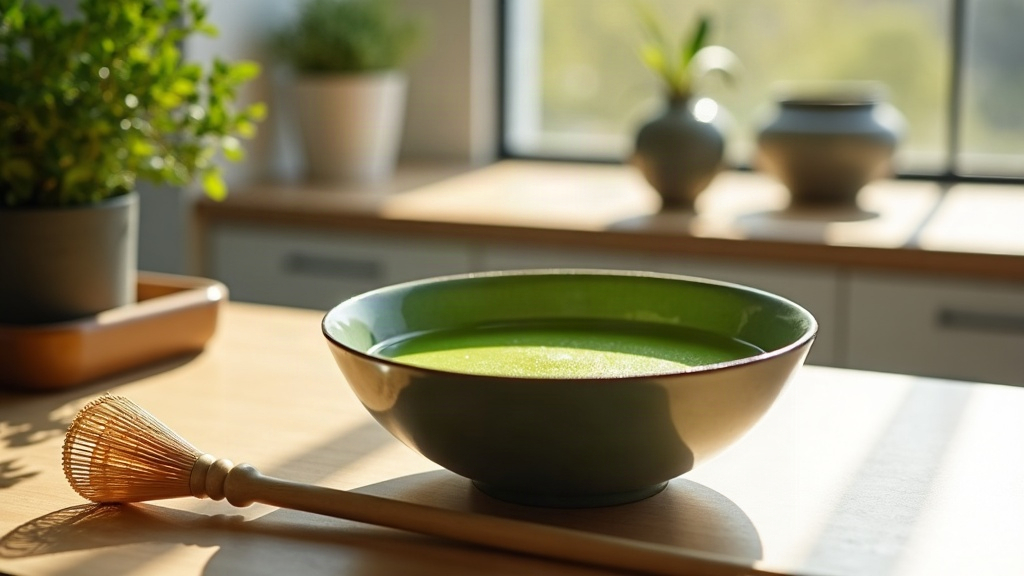
If you have been paying attention to any food or beverage trend this year, you already know matcha is everywhere. Ceremonial-grade powder, adaptogen matcha lattes, oat milk matcha, banana bread matcha from Starbucks. The hashtag #matchalatte pulls millions of views a month on Instagram and TikTok, and menu data shows matcha items are up more than 30% year over year. According to food industry tracking, matcha mentions have surged 107% compared to last year. This is not a flash-in-the-pan moment. Matcha has become a full-on morning ritual for a huge chunk of people who want something between tea and coffee, with a slower, steadier energy hit and a flavor profile that rewards attention.
Part of the appeal is the craft of it. You source good ceremonial-grade powder, you get a bamboo whisk, you learn the proper water temperature (not boiling, around 175 degrees F), you find the right bowl. There is a meditative quality to the whole process that flat-out does not exist with a drip coffee maker. People are genuinely investing in their home matcha setup, and for good reason: a high-quality bowl of matcha, made well, is exceptional.
Which makes it all the more frustrating when your home matcha, made with premium powder you paid real money for, still tastes slightly off. A little harsh. A little flat. Nothing like the bowl you had at that coffee shop downtown.
Boise's Matcha Scene Is Having a Moment
Boise has quietly built a legit matcha culture. Wanna Matcha serves ceremonial-grade lattes with clean, bright flavor. Neckar Coffee and Alchemist Coffee Roasting Co both do matcha right alongside their single-origin espresso programs. Push and Pour draws a morning crowd that takes both coffee and tea seriously. Out on the west side, Mr. Tea at 6932 W State St brings a Vietnamese boba and matcha tradition that has its own following. These are not places just slapping a green powder into warm milk. These are shops where someone has thought carefully about the product.
The Treasure Valley's interest in matcha also tracks with a broader wellness shift. People here are reaching for lower-anxiety caffeine, cleaner ingredients, and drinks that feel intentional rather than automatic. Whether you are in Meridian, Boise, or Eagle, the morning matcha ritual has become genuinely common, and the home matcha market has grown with it.
The One Question Nobody Answers
Here is the thing about matcha tutorials and YouTube guides and Reddit threads on sourcing the best ceremonial grade: they spend enormous amounts of time on powder quality, water temperature, whisk technique, and even the type of bowl. What almost none of them address seriously is the water itself.
Not whether it is hot enough. Not how much you use. But what is actually in the water you are whisking with.
This matters more than almost anything else in the process, and if you live in Boise or Meridian, it is almost certainly the reason your home matcha does not taste as good as the coffee shop's.
What Boise Tap Water Does to Your Matcha
Boise and Meridian water runs between 10 and 17 grains per gallon (gpg) of hardness. To put that in context, the national average is around 7 to 8 gpg. Our water is, by any measure, very hard. That hardness comes from calcium and magnesium picked up as groundwater moves through Idaho's mineral-rich geology, the same geology that Boise State and Idaho State University researchers are now studying as they explore underground dam systems to manage regional groundwater storage. The minerals are natural and harmless to drink, but they are not neutral when it comes to what you are cooking or brewing with.
Matcha gets its character largely from EGCG, a catechin compound that accounts for the umami, the slight sweetness, and the smooth finish in a well-made bowl. When high-calcium water hits those catechins, you get a chemical reaction that suppresses the umami and amplifies astringency. The harder the water, the more pronounced the effect. At 10 to 17 gpg, Boise tap water is pushing well into the range where this reaction is noticeable in the cup. You are not imagining the bitterness. You are tasting real chemistry.
Then there is the emulsification problem. Proper matcha preparation depends on the powder suspending evenly in the water to create that characteristic froth. Hard water interferes with this process. The calcium and magnesium ions compete with the powder's ability to emulsify, which means your whisk is working harder for less froth, and you may be getting clumping that a soft-water bowl would not produce.
One more layer: Boise and Meridian water is treated with chloramine rather than free chlorine. Unlike chlorine, chloramine does not off-gas when you let water sit. It stays in solution even after you heat it, and it adds a subtle chemical undertone that is particularly noticeable in delicate, flavor-forward drinks like matcha. The EPA notes that chloramine is effective at disinfection, but its persistence is exactly what makes it a problem for high-flavor beverages.
Why Your Local Matcha Bar Tastes Different
This is not a secret in the specialty beverage world. Premium matcha bars in Japan have used filtered or soft water for generations, and serious cafes here in the U.S. do the same. The shops in Boise that are doing matcha well are not just using better powder than you can find at the grocery store. They are also controlling their water.
A reverse osmosis system, a water softener, or even a quality inline filter removes the calcium, magnesium, and chloramine that are working against your cup. What you are left with is nearly neutral water, the kind that lets matcha's EGCG catechins do exactly what they are supposed to do. The umami comes forward. The finish is clean. The froth sets properly. It tastes like what you paid for.
This is also why the same matcha powder can taste dramatically different depending on where you make it. Take your ceremonial-grade bag to a friend's house in a city with naturally soft water and make the same bowl. You will taste the difference immediately. The powder did not change. The water did. For more on how Boise's mineral profile affects everyday beverages, see our breakdown of how hard water affects coffee in Boise, and our complete guide to hard water in Boise if you want the full picture.
The Fix Is Simpler Than You Think
You have a few options depending on how deep you want to go.
The easiest starting point is a pitcher filter or a faucet-mounted carbon block filter. These will knock out the chloramine and some of the heavier mineral load. They are inexpensive and you will notice an improvement in your matcha right away. The tradeoff is that they do not remove hardness fully, and you will be replacing cartridges regularly.
A step up from there is a reverse osmosis system under the kitchen sink. RO strips virtually all dissolved minerals, including calcium and magnesium, and produces water that is very close to ideal for matcha preparation. A good under-sink RO unit typically runs $300 to $600 installed. If matcha, coffee, and cooking quality matter to you, it pays for itself fairly quickly in the gap between what you are currently tasting and what you should be tasting.
A whole-home water softener handles the problem at a different level. It addresses the hardness throughout your entire house, which means softer water for your appliances, your shower, your laundry, and yes, your kitchen. For Treasure Valley homes running at 10 to 17 gpg, a quality water softener system typically runs $2,500 to $4,500 installed. It solves the matcha problem, but it also solves a dozen other hard-water problems at the same time. The free water test our team offers is a good first step if you want to know exactly what your water contains before deciding which solution makes sense.
Find Out What's in Your Boise Water
Our free water test shows you exactly what minerals are affecting your coffee, matcha, and everything else you cook and drink. No pressure, no sales pitch.