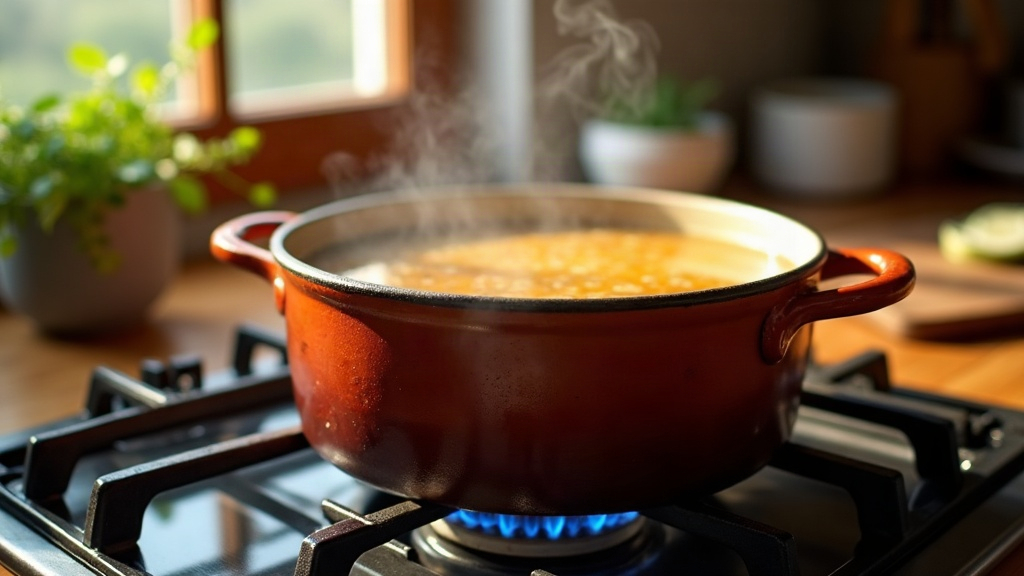
Bone broth season is back. Across the Treasure Valley, home cooks are pulling out their biggest stockpots, raiding the butcher counter for knuckle bones and chicken backs, and setting timers for 12, 18, even 24-hour simmers. The slow, rich smell of bones reducing on the back burner is basically the unofficial start of fall in Meridian.
And bone broth has never been more popular. GLP-1 medications like Ozempic have pushed a wave of people toward high-quality, easy-to-digest protein. The gut health movement has gone fully mainstream. Gelatin is having a moment. Home cooks share their "jello test" results on social media: tip the jar after cooling, watch it slide out in one solid quiver. That's the win people are chasing.
But there's one ingredient nobody talks about: the water. If you're filling your pot from a Boise or Meridian tap, you might be unknowingly working against yourself.
Why Bone Broth Is Having Its Biggest Moment Yet
Two converging trends are behind this year's bone broth boom, and neither one is slowing down.
First, the GLP-1 wave. Millions of people on medications like Ozempic or Wegovy are eating significantly smaller portions. When you eat less volume, every bite and every sip has to count nutritionally. Bone broth delivers a concentrated hit of collagen, gelatin, and amino acids without a lot of bulk. It fits naturally into that lifestyle.
Second, gut health has moved from fringe to mainstream. Gelatin coats the gut lining, supports the mucosal barrier, and feeds the microbiome. Registered dietitians now routinely mention bone broth alongside probiotic foods. What was once the domain of ancestral diet communities is now covered by mainstream nutrition media every week.
The jello test has become a badge of honor. If your cooled broth gels solid and holds its shape when you flip the jar, you won your batch. You extracted meaningful collagen from the bones. That's the goal, and it's the part where your water matters most.
The Hidden Ingredient in Every Batch
Most bone broth guides skip right over this: you are not just cooking bones. You are cooking bones in mostly water. At the start of a 24-hour simmer, your pot is 80 to 85 percent water by volume. Whatever was dissolved in your tap water does not leave. It stays and concentrates alongside everything else being extracted from the bones.
In the Treasure Valley, that matters a lot. Boise tap water typically measures 10 to 13 grains per gallon (gpg) of hardness. Meridian and Eagle run harder, 12 to 17 gpg depending on the neighborhood and the time of year. The USGS classifies anything over 10.5 gpg as "very hard." Most of the Treasure Valley is living in that zone.
Three water quality factors affect your broth: hardness (dissolved calcium and magnesium), chloramine (the disinfectant Boise and Meridian add to drinking water), and total dissolved solids (TDS). All three are present in Treasure Valley tap water, and all three have measurable effects on what ends up in your bowl.
What Hard Water Actually Does to Your Broth
Dissolved calcium and magnesium, the minerals that make water "hard," compete with the collagen extraction process. Collagen molecules in bone connective tissue need to be coaxed out through long, gentle heat. When the water already carries a high mineral load, that process gets less efficient. The result is broth that doesn't gel as well, staying loose or watery after cooling instead of setting up firm and jiggly.
Hard water also contributes to cloudiness. Bone broth made with soft or filtered water tends to clarify more easily, producing a cleaner, more amber finished product. Hard water keeps more particles in suspension, especially in a large pot over 24 hours. If your broth never looks quite as clear as the photos you see online, your water might be part of the answer.
Skimming foam is harder too. That gray scum rising in the first 30 minutes of a simmer is easier to remove when it forms clean, defined rafts. In hard water, mineral interference breaks the foam into smaller fragments that scatter across the surface.
There is one more factor specific to this season. Canyon County is under a drought emergency in 2026, which means municipal systems across the Treasure Valley are drawing more heavily from groundwater sources. Groundwater in this region tends to be harder than surface water. If your broth seems harder to gel this fall compared to last year, the water itself may be running harder right now.
The Chloramine Problem Nobody Mentions
Most experienced home cooks know to let tap water sit uncovered before using it in fermentation or delicate cooking. The goal is to let chlorine off-gas. That works for chlorine, but Boise and Meridian use chloramine, not free chlorine, as their primary disinfectant. Chloramine does not evaporate. Leaving water in a bowl on the counter overnight does nothing to remove it.
Boise's treated water typically carries 0.5 to 1.2 mg/L of chloramine residual, well within EPA safety limits but present and persistent. Over a 24-hour simmer, chloramine stays in the liquid the entire time. It does not break down with heat. At low levels, it contributes a faint medicinal or slightly off undertone, the kind that's hard to identify but makes your broth taste like something is missing.
A carbon block filter or reverse osmosis system removes chloramine effectively. A standard salt-based water softener does not. This is a key distinction: if you have a whole-home softener and your broth still tastes slightly off, the softener isn't the problem, but it's also not the full solution for chloramine. An under-sink RO or a dedicated carbon filter on your kitchen tap handles that piece.
What Filtered Water Does to Your Results
Soft or filtered water extracts more cleanly from bones. With mineral competition removed, collagen comes out of the connective tissue more efficiently. That translates to a better gelatin set, cleaner flavor, and better visual clarity in the finished broth. For home cooks who are serious about their results, this is one of the most consistent, reproducible improvements you can make without changing anything else in your technique.
Reverse osmosis is the gold standard for cooking water. An RO system removes hardness, chloramine, TDS, and most other dissolved contaminants. What goes into your pot is essentially neutral, which lets the flavor of the bones and aromatics come through cleanly. Many serious home cooks use RO water for stocks and broth specifically for this reason.
A whole-home water softener is a significant upgrade for everything cooked with tap water: pasta, rice, soups, tea, and yes, bone broth. It removes the hardness that interferes with gelatin extraction and clarity, and it protects your cookware and appliances at the same time. For chloramine removal, pairing a softener with an under-sink carbon or RO filter on your kitchen tap covers all the bases.
If you've been following the conversation about how hard water affects collagen supplements and skin absorption, the mechanism here is similar. Hard water mineral interference shows up in multiple places in daily life, from your skincare routine to your stockpot.
The first step is knowing exactly what you're working with. Water Softener Boise offers a free water test for Treasure Valley homeowners. You get your actual hardness number, TDS reading, and chloramine confirmation, so you know precisely what's going into the pot and what, if anything, to do about it.
Free Water Test
Find Out What's in Your Water
Know your hardness, TDS, and chloramine levels before your next batch. No charge. No pressure. Serving Meridian, Boise, Eagle, Nampa, and surrounding Treasure Valley.